
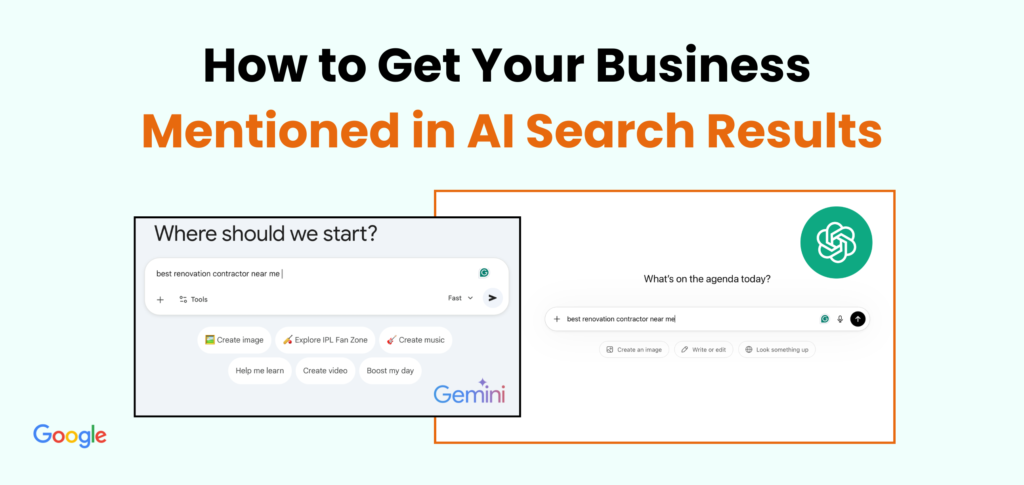
Published: 2026 | Author: Fateh Digital Solutions | Location: Brampton, Ontario
Introduction: The AI Search Revolution Has Already Begun
Not long ago, getting found online meant one thing: ranking on the first page of Google. Business owners invested in SEO, built backlinks, wrote blog posts, and competed fiercely for those ten blue links at the top of the search results page.+1
That world is rapidly changing.
Today, when someone searches for a service — whether it’s a plumber in Brampton, a real estate agent in Mississauga, or a digital marketing agency in Toronto — they don’t always scroll through a list of websites. Instead, they get a direct AI-generated answer at the very top of the page.+1
Google’s AI Overviews, ChatGPT Search, Microsoft Copilot, and Perplexity AI are now answering millions of queries every day without sending users to any website at all. This shift is called AI search, and it is one of the most significant changes in online marketing since Google was founded.+1
For small business owners in Canada, this creates both a challenge and a massive opportunity:
- The challenge: If your business isn’t being mentioned or recommended in these AI-generated answers, you’re invisible — even if you rank on page one.
- The opportunity: Most small businesses haven’t adapted yet, which means there is a real first-mover advantage for those who act now.
This guide explains exactly what AI search is, why it matters for your business, and — most importantly — the specific, practical steps you can take to get your business mentioned, cited, and recommended by AI search engines in 2026 and beyond.
Part 1: Understanding AI Search — What It Is and How It Works
1.1 What Is AI Search?
AI search refers to search engines and AI assistants that use large language models (LLMs) to generate answers directly from their understanding of the web — rather than simply showing a ranked list of links.
The major AI search tools your customers are already using include:
- Google AI Overviews (formerly Search Generative Experience) — Now appears at the top of billions of Google searches worldwide.
- ChatGPT Search — OpenAI’s web-connected version of ChatGPT that searches in real time.
- Microsoft Copilot (powered by Bing) — Integrated into Windows, Microsoft Edge, and Office products.
- Perplexity AI — A standalone AI search engine gaining millions of users rapidly.
- Meta AI — Now integrated into Facebook, Instagram, and WhatsApp.
When a user asks any of these tools a question, the AI reads and synthesizes information from dozens of web sources and produces a single, confident answer. It may cite some sources, but often it doesn’t — it simply gives the answer. If your business is one of those sources, or if your brand is consistently recommended across the web, you get mentioned. If not, a competitor does.+3
1.2 How AI Search Engines Decide What to Recommend
AI search engines don’t rank websites the same way traditional Google does. They look for signals of trust, authority, relevance, and consistency.+1
The core factors that determine whether your business gets mentioned include:
- Content Quality and Depth: AI tools favour websites that provide thorough, expert-level answers — not thin pages with generic content.
- Entity Recognition: AI systems build a model of ‘entities’ — businesses, people, and organizations they recognize as real and established. If the AI knows who you are across multiple sources, it’s more likely to recommend you.+1
- Trust Signals: Reviews, awards, directory listings, press mentions, and consistent business information all tell the AI that you’re a legitimate, credible business.
- Structured Data: Technical markup on your website (called schema) tells AI systems exactly what your business does, where you’re located, and what you offer — in a language they can easily read.
- Topical Authority: A business with deep, consistent content on a specific topic is treated as a subject matter expert. AI tools prefer to cite experts.+1
1.3 Why Traditional SEO Alone Is No Longer Enough
Traditional SEO — getting on page one of Google — still matters, but it’s no longer sufficient on its own.
When Google shows an AI Overview at the top of the search results page, studies show that users increasingly click on the AI answer rather than scrolling down to the organic results. This means your page-one ranking gets fewer clicks than it used to. This phenomenon is called “zero-click search,” and it’s growing rapidly.+2
Businesses that only focus on traditional SEO will see their organic traffic decline over time — not because they’re doing anything wrong, but because AI is absorbing the clicks that used to go to websites.
The solution is not to abandon SEO. It’s to add AI Search Optimization (AISO) on top of it — so that when the AI generates its answer, your business is the one being cited, mentioned, or recommended.
Think of it this way: Traditional SEO gets you on the menu. AI search optimization gets you recommended by the waiter.+1
Part 2: The 10 Strategies to Get Your Business Mentioned in AI Search
Strategy 1: Write Content That Directly and Completely Answers Questions
This is the single most important thing you can do. AI search engines are answer machines. They’re trained to find the best possible answer to a question and present it clearly. If your website content is structured as clear, authoritative answers to the questions your customers ask, AI tools will pull from it.+2
Why This Works
When you write a blog post titled “How much does local SEO cost in Canada?” and you answer it thoroughly — with context, examples, and specific numbers — an AI tool reading thousands of websites will recognize your content as a strong, direct answer to that exact query. It’s far more likely to cite your page than a competitor’s page that only mentions SEO pricing in passing.+1
How to Implement This Strategy
- Research the exact questions your customers ask Google, ChatGPT, or Siri using tools like AnswerThePublic, AlsoAsked, or Google’s “People Also Ask” boxes.
- Create dedicated content for each question — such as blog posts, FAQ pages, or expanded service pages.
- Structure your answers clearly: state the answer in the first 2–3 sentences, then provide detailed context below.
- Use natural, conversational language — write the way people speak, not the way robots write.
- Cover follow-up questions within the same piece of content, as AI tools prefer comprehensive resources.
- Aim for a minimum of 1,500 words for major topic pages to signal depth and authority.
- Update your content at least once a year to keep it fresh and accurate.
💡 Pro Tip: Add a bolded “Quick Answer” section at the very top of your blog posts. AI tools often pull from the first clear summary they encounter.+1
Strategy 2: Fully Optimize Your Google Business Profile
Your Google Business Profile (GBP) is one of the most powerful levers you have for AI search visibility — especially for local queries. Google’s AI Overviews pull heavily from GBP data when answering questions like “best plumber near me”or “digital marketing agency in Brampton.”+1
Complete GBP Optimization Checklist
- Business Name, Address, and Phone Number (NAP): Must be 100% accurate and match every other listing online.
- Business Description: Write at least 250 words that naturally include your key services and location keywords.
- Categories: Choose your primary category carefully and add 3–5 secondary categories.
- Services: List every single service with a clear name and description.
- Hours: Keep them current, including holiday hours.
- Photos: Upload a minimum of 20 high-quality photos (team, office, work samples, before/after).
- Posts: Publish at least one update per week (offers, news, tips, events).
- Q&A: Add your own questions and answers proactively; don’t wait for customers to ask.
- Reviews: Respond to every single review within 48 hours.
- Products/Services Menu: Fill these in completely if applicable.
💡 Pro Tip: GBP posts that include keywords relevant to your services are significantly more likely to be referenced by Google’s AI in local search results.
Strategy 3: Build a Powerful Review Ecosystem
Reviews are one of the strongest trust signals that AI search engines use when deciding which businesses to recommend. To recommend a business safely, the AI needs confidence that you are legitimate and deliver on your promises. Reviews provide that crucial social proof.+2
AI systems heavily favor reviews that are:
- Recent: Published within the last 6–12 months.
- Specific: Mentioning actual services, results, or experiences.
- Diverse: Spread across multiple platforms (Google, Clutch, Trustpilot, etc.).
- Responded to: Showing that the business is active and engaged.
Building Your Review Strategy
- Ask every satisfied customer for a review immediately after project completion.
- Send a follow-up email 3 days after service with a direct link to your Google review page.
- Train your team to ask for reviews in person — a personal ask is far more effective than an automated email.
- Get listed and reviewed on industry-specific platforms: Clutch or GoodFirms (marketing), Houzz (home services), Healthgrades (healthcare), or Zillow (real estate).
- Never buy fake reviews — AI systems easily detect inauthentic patterns, and penalties are severe.
- Respond to negative reviews professionally and offer to resolve issues to demonstrate accountability.
Note: Businesses with 50+ Google reviews averaging 4.5 stars or higher are significantly more likely to appear in AI-generated recommendations for local searches.
Strategy 4: Get Mentioned on Authoritative External Websites
AI search engines learn about your business from what the rest of the internet says about you — not just your own website. When reputable, high-authority websites reference your brand, it validates your existence and expertise.+1
Types of External Mentions to Pursue
- Local Business Directories: Yellow Pages Canada, Canada411, your local Chamber of Commerce, and the BBB (Better Business Bureau).
- Industry-Specific Directories: Clutch, GoodFirms, UpCity, DesignRush, Sortlist, or Houzz.
- Guest Blog Posts: Write expert articles for industry publications that link back to your website.
- Press Releases: Issue releases for significant milestones like a new office, major client wins, awards, or team growth.
- Local News Features: Reach out to local Brampton, Mississauga, or GTA news outlets with unique story ideas.
- Podcast Appearances: Feature as a local business expert; a mention with your website URL is a powerful authority signal.
- Partner Cross-Promotion: Collaborate with complementary, non-competing businesses for mutual mentions.
- “Best of” Lists: Actively pursue inclusion in annual “best agencies” or “top businesses” lists in your city.
💡 Pro Tip: When you earn an external mention, make sure your business name, website URL, and location are all clearly included. AI systems use these three pieces together to connect the mention back to your entity.+1
Strategy 5: Implement Schema Markup on Your Website
Schema markup is structured data code added to your website’s HTML that tells AI systems exactly what your business is, what it does, and key facts about it. Think of it as a direct communication channel that hands the AI information on a silver platter rather than forcing it to guess.+2
Essential Schema Types for Small Businesses
- LocalBusiness schema: Your business name, address, phone, hours, geo-coordinates, and service area.
- Service schema: Detailed descriptions of each individual service you offer.
- FAQPage schema: Marks up your FAQ content so it can be directly pulled into AI answers.
- Review schema: Highlights your aggregate rating and individual customer reviews.
- Article schema: Marks up your blog posts as authoritative content pieces.
- Organization schema: Establishes your business as a recognized entity with official social profiles.
Implementation Tip: If you’re using WordPress, plugins like Rank Math or Yoast SEO can help with basic schema. For advanced service and FAQ implementations, working with a professional digital marketing agency ensures it is done correctly. Google has publicly confirmed that structured data helps their systems better understand content, translating directly into better chances of being cited in AI Overviews.+2
Strategy 6: Build Deep Topical Authority in Your Niche
AI search engines don’t just evaluate individual pages — they evaluate your entire website as a whole. A business that has consistently produced in-depth, expert content on a specific topic over time is treated as an authority. Authorities get recommended; thin, shallow websites don’t.+2
What Topical Authority Looks Like in Practice
Imagine two landscaping companies in Brampton:
- Company A has a homepage, a services page, and a contact page — nothing else.
- Company B has all of that plus a blog with 30+ posts covering lawn care, interlocking, irrigation, and landscape design; detailed individual service pages; a FAQ page answering 25 common customer questions; and a seasonal guide to lawn care in the Brampton/Peel Region climate.+1
When someone asks an AI, “What are the best landscaping tips for a Brampton lawn in spring?”, Company B will win the mention every single time.
How to Build Your Topical Authority Content Plan
- Identify your 5–8 core topic pillars (the main subjects your business operates in).
- For each pillar, plan 10–15 supporting content pieces: how-to guides, FAQs, comparisons, and local case studies.
- Publish consistently — even one high-quality post per week adds up to 50+ pieces per year.
- Link your content together strategically using internal links to help AI systems understand the relationships between pages.
- Update old content to signal freshness, as outdated articles signal stale expertise.
- Cover the full customer journey: awareness (what is X?), consideration (X vs Y), and decision (best X in Brampton).
💡 Pro Tip: Create a “hub and spoke” content structure: one comprehensive guide on a topic (the hub) linked to and from multiple shorter, specific articles (the spokes). This architecture signals deep expertise to AI systems.+1
Strategy 7: Maintain Perfect NAP Consistency Across All Platforms
NAP stands for Name, Address, and Phone Number. AI systems cross-reference your business information across dozens of sources to verify that you’re a real, legitimate entity. If your business name is spelled differently on Yelp than on your website, or your phone number is inconsistent, the AI’s confidence drops and it won’t recommend you.+2
NAP Consistency Audit: What to Check
- Your own website (homepage, contact page, footer)
- Google Business Profile
- Facebook Business Page & Instagram bio +1
- LinkedIn Company Page
- Yelp, Yellow Pages Canada, Canada411, and BBB listings
Note: Even minor differences matter. Variations like “123 Main St” vs “123 Main Street” or “Fateh Digital Solutions Inc.” vs “Fateh Digital Solutions” can create enough inconsistency to confuse AI systems. Tools like BrightLocal, Moz Local, or Whitespark (which specializes in the Canadian market) can automatically scan and help you fix these.+2
Strategy 8: Establish Your Business as a Recognized Entity
In the world of AI and knowledge graphs, an ‘entity’ is a real-world thing — a business, a person, a place — that AI systems recognize clearly. When your business becomes a recognized entity, AI tools know exactly who you are without needing to guess, allowing them to confidently reference you.+1
How to Build Entity Status
- Google Knowledge Panel: Build one by ensuring consistent, authoritative information across many sources until Google displays an information box on the right side of search results.
- Wikidata: Adding your business to Wikidata (the structured data layer behind Wikipedia) helps AI systems recognize your brand.
- Crunchbase: Highly trusted and frequently referenced by AI, making it especially useful for agencies and B2B businesses.
- LinkedIn Company Page: Fill this out completely and post regular updates, as LinkedIn is treated as a high-authority source.
- Consistent Brand Voice: Use your exact legal business name consistently everywhere; avoid abbreviations or variations.
Strategy 9: Optimize for Voice Search and Conversational Queries
A significant portion of AI search queries come from voice — people talking to Siri, Alexa, Google Assistant, or ChatGPT. Voice queries are structurally different from typed keywords:+1
- Typed query: ‘digital marketing agency Brampton’
- Voice query: ‘Hey Google, who is the best digital marketing agency near me in Brampton?’
Voice Search Optimization Tactics
- Write content in a natural, conversational tone — avoid overly formal or technical language.
- Target long-tail, question-based keywords (e.g., “how much does X cost in Brampton” or “what is the best X for Y”).
- Use “near me” optimization by making sure your location is prominent in your content and schema markup.
- Keep paragraphs and sentences short, as AI voice responses prefer concise, scannable content.
💡 Pro Tip: After writing any FAQ answer, read it aloud. If it sounds natural spoken, it’s optimized for voice. If it sounds robotic or stilted, rewrite it.+1
Strategy 10: Monitor Your AI Search Presence and Adapt
AI search is evolving faster than any other aspect of digital marketing. The strategies that work today will need refinement as AI tools update their algorithms.+1
How to Monitor Your Presence
- Search your target queries in Google and check if AI Overviews appear — look to see if you are mentioned.
- Ask ChatGPT and Perplexity directly: “What are the best digital marketing agencies in Brampton?” — see if your business comes up.
- Use Google Search Console to monitor impressions and clicks coming from AI Overview traffic.
- Set up Google Alerts for your business name to track new mentions across the web.
- Track your local search rankings and GBP Insights monthly using tools like BrightLocal or Whitespark.
Part 3: How Long Does It Take to See Results?
AI search optimization is not a quick fix. Like traditional SEO, it is a long-term investment that compounds over time. Here is a realistic timeline for what to expect:+1
| Timeline | Phase | Focus Area |
|---|---|---|
| Months 1–2 | Foundation | Schema markup implemented, GBP fully optimized, NAP audit completed, review strategy launched. |
| Months 2–3 | Visibility Building | Content publishing in full swing, external citations growing, initial mentions in local AI results. |
| Months 3–6 | Authority Establishment | Topical authority recognized, consistent appearance in AI Overviews for target queries, increasing brand mentions. |
| Months 6–12+ | Compounding Growth | Entity recognition established, regular recommendation in AI results, measurable increase in organic leads and inquiries. |
Export to Sheets
The businesses winning AI search in 2027 are the ones building their foundation today. Every month you delay is a month your competitors can use to get ahead.+1
Part 4: Common Mistakes That Keep Businesses Out of AI Results
Avoid these frequent mistakes that prevent small businesses from showing up in AI search results:
- Thin, Generic Website Content: Pages with 200–300 words of vague, keyword-stuffed content tell AI systems that you don’t have real expertise.
- Ignoring Google Business Profile: An incomplete or outdated GBP is one of the fastest ways to become invisible in local AI search.
- No Reviews or Stale Reviews: A business with 5 reviews from 3 years ago signals to the AI that you may no longer be active or trusted. Fresh, specific reviews are essential.+1
- Inconsistent Business Information: NAP inconsistencies across directories create confusion for AI systems and actively harm your credibility.
- No Schema Markup: Without structured data, AI systems have to guess what your content means. Not implementing schema is leaving visibility on the table.
- Only Focusing on Traditional SEO: If your entire strategy is built around traditional page-one rankings without any consideration for AI search, you’re optimizing for a world that is rapidly disappearing.
- Treating AISO as a One-Time Project: AI search optimization is an ongoing discipline. Businesses that implement strategies once and never revisit them will see results plateau and eventually decline.+1
Ready to Get Your Business Mentioned in AI Search Results?
At Fateh Digital Solutions, we specialize in AI Search Optimization (AISO) — a comprehensive service designed to position Canadian small businesses at the forefront of the AI search revolution.
Our AISO service covers everything discussed in this guide: technical schema implementation, content strategy, Google Business Profile optimization, citation and authority building, voice search optimization, and ongoing monitoring and reporting. We’ve helped businesses across multiple industries — real estate, healthcare, construction, landscaping, beauty, and more — dramatically increase their visibility in AI-generated search results.+1
What You Get With a Free Strategy Call:
- A personalized audit of your current AI search visibility.
- An analysis of where your competitors are showing up in AI results.
- A clear action plan tailored to your business, industry, and location.
- Honest, pressure-free recommendations on what will make the biggest impact for your specific situation.
Book Your Free Strategy Call Today
- Website: fatehdigitalsolutions.com
- Phone: +1 437-243-2529
- Email: support@fatehdigitalsolutions.com
- Address: 35 Finsbury Dr, Brampton, ON L6T 3R2, Canada
© 2026 Fateh Digital Solutions. All Rights Reserved. Award-winning digital marketing agency serving small businesses across Canada.